HomeSLP
From 1 Word to 3+: Building Sentences
How to help your child go from using single words to combining words into phrases and short sentences.
Parents of children 18-36 months transitioning to multi-word speech
The Building Blocks
Before your child can combine words, they need a vocabulary foundation. Research suggests children typically start combining two words when they have around 50 words in their vocabulary. These building blocks include nouns, verbs, descriptors, and social words.
- Nouns (naming words): mama, ball, dog, car, cup, shoe
- Verbs (action words): go, eat, open, push, help, want
- Descriptors: big, hot, yucky, more, all gone
- Social words: hi, bye, no, yes, please, uh-oh
- Location words: up, down, in, out, here
- Aim for a mix of word types — verbs are especially important for combining
Tip
Children who know mostly nouns have a harder time combining words. Verbs are the glue of sentences. Model lots of action words: push, go, eat, open, help, want, see, hear.
Expanding Utterances
The simplest strategy for building sentences is expansion: take what your child says and add one word to it. This models the next step without overwhelming them. Keep your expansion just one step ahead of where they are.
- Child says 'ball' → You say 'big ball' or 'throw ball' or 'red ball'
- Child says 'more' → You say 'more crackers' or 'want more'
- Child says 'go' → You say 'car go' or 'daddy go' or 'go fast'
- Child says 'mama up' → You say 'mama pick up' or 'mama stand up'
- Always keep your expansion natural — don't make it feel like a correction
Using Carrier Phrases
Carrier phrases are short, predictable sentence starters that your child can learn to use with many different words. Once they learn the phrase, they can swap in new words to create many different sentences.
- 'I want ___' (I want milk, I want ball, I want up)
- 'I see ___' (I see dog, I see bird, I see mama)
- 'More ___' (more juice, more play, more book)
- 'Go ___' (go car, go outside, go park)
- 'No ___' (no bath, no bed, no peas)
- '___ gone' (milk gone, daddy gone, all gone)
Note
Carrier phrases may sound a bit robotic at first, and that's okay. They give your child a framework for combining words. Natural sentence variation will come with time and practice.
Daily Opportunities
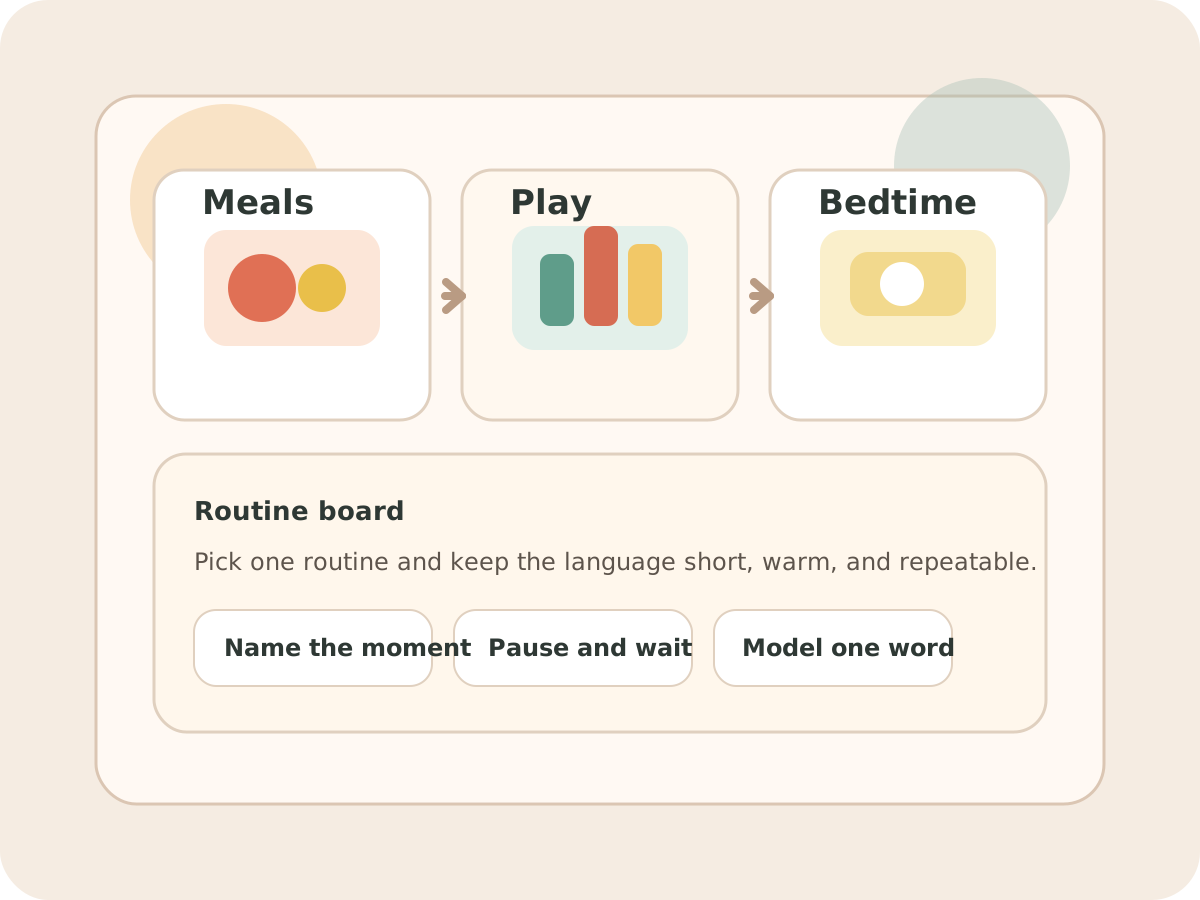
Every moment of your day has opportunities to model and encourage multi-word combinations. You don't need to set aside special practice time — just build it into what you're already doing.
- Meals: 'eat banana,' 'drink milk,' 'more please,' 'all done eating'
- Getting dressed: 'shoes on,' 'shirt off,' 'blue socks,' 'zip up'
- Outside: 'big truck,' 'bird fly,' 'dog run,' 'push swing'
- Bath time: 'wash hands,' 'water hot,' 'pour water,' 'rubber duck'
- Car rides: 'go fast,' 'red car,' 'see bus,' 'beep beep'
- Bedtime: 'read book,' 'night night bear,' 'light off,' 'hug mama'
Celebrating Progress
Language development is a gradual process. Celebrate the small steps and recognize that every new word combination is a milestone worth acknowledging. Your enthusiasm and responsiveness are the most powerful motivators for your child.
- Respond with excitement to new word combinations: 'You said two words together!'
- Repeat their combination back to confirm: Child says 'big dog' → 'Yes! Big dog!'
- Don't correct grammar at this stage — 'me want' is a great two-word combination
- Keep a log of new word combinations to track progress over time
- Share successes with your SLP so therapy goals can be updated
- Remember: word approximations count — 'mo cah' for 'more crackers' is combining!
Tip
Progress isn't always linear. Your child might have a burst of new combinations, then plateau for a few weeks. This is completely normal. Keep modeling and the next burst will come.
This handout is for educational purposes and does not replace professional evaluation or treatment. If you have concerns about your child's development, consult a licensed speech-language pathologist.
HomeSLP — homeslp.onrender.com